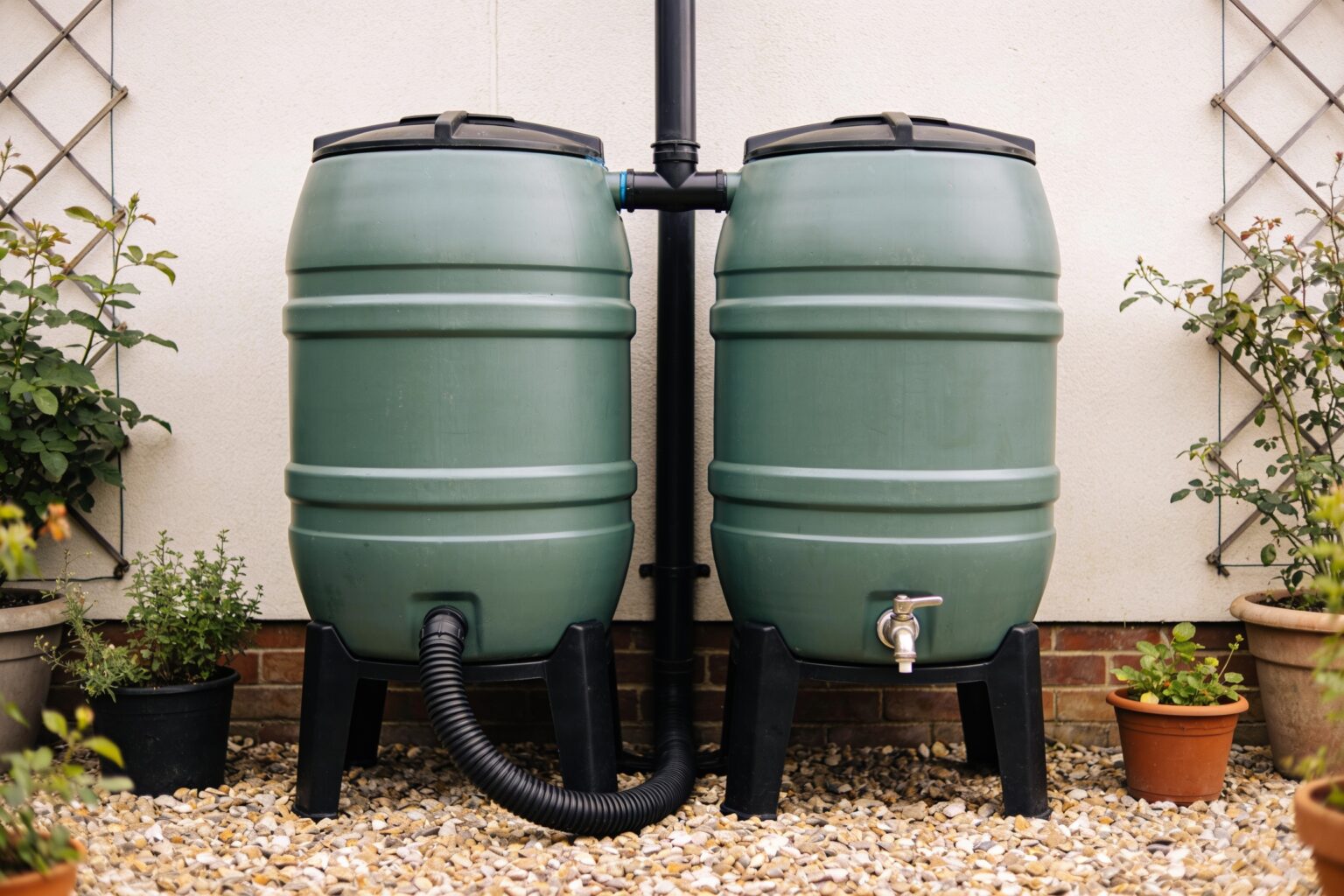
Quick answer: To link two water butts, stand them side by side at the same height and drill a hole near the base of each. Fit a tank connector to each hole and join them with a short hose from a linking kit. The butts then fill and empty together. Only the first butt needs a rain diverter. To fill them one after the other instead, link them near the top.
Once you’ve had a water butt for a summer, there’s a good chance you’ll want more storage. A full 200 litre butt can disappear surprisingly quickly in a heatwave. The easiest way to get more is to link a second butt to the first.
This guide explains the two ways to link water butts, what kit you need, exactly how to do it, and how to stop a butt overflowing.
Why link water butts?
- More water in the same spot. Two 210 litre butts give you 420 litres from one downpipe.
- Easier than one huge tank. Smaller butts are lighter, cheaper and easier to fit into awkward spaces.
- Spread the cost. Start with one butt and add another next year.
- Spread the weight. Two butts on two stands spread the load more evenly than one giant tank.
- Catch more rain. On a big roof, a single butt fills fast and the rest goes down the drain.
The RHS also suggests linking slimline water butts as a way to collect and store more rainwater where space is limited.
Two ways to link water butts
Option 1: Linking at the base (fill together)
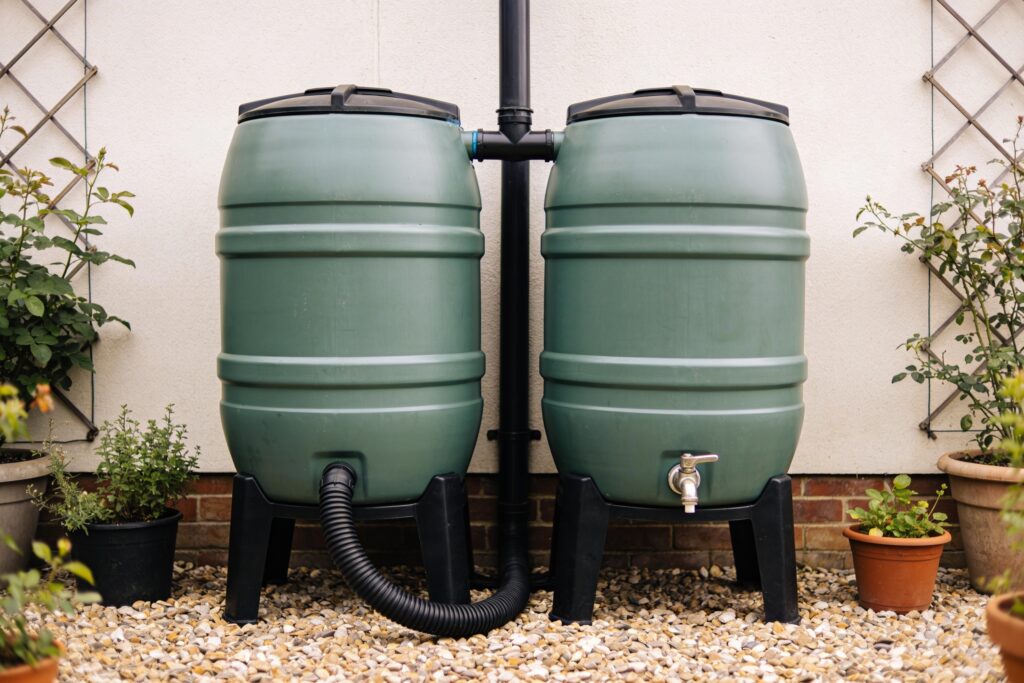
A short hose joins the two butts near their bottoms. As the first butt fills from the diverter, water flows across to the second until both are at the same level. They fill together and empty together, so you can draw water from either tap.
Best for: butts standing side by side at the same height. This is the most common method and what most water butt linking kits are designed for.
Option 2: Linking at the top (fill in turn)
A hose joins an outlet near the top of the first butt to an inlet on the second. The second butt only starts to fill once the first is full.
Best for: butts at different heights, or when you want the first butt always kept full. It’s also how an overflow kit works.
| Base linking | Top (overflow) linking | |
|---|---|---|
| How they fill | Together | One after the other |
| Water levels | Always equal | First full, second fills next |
| Butts at different heights | Not suitable | Suitable |
| Use either tap | Yes | Yes, but levels differ |
| Most common | ✔ |
What you need to link water butts
- Two (or more) water butts, ideally the same model and size.
- A linking kit: usually two tank connectors with seals and back nuts, plus a length of hose. 25 mm hose is the most common.
- Two matching stands, or one level base big enough for both.
- A drill and hole saw of the size your kit specifies. Hole sizes vary, so check before drilling.
- Hose clips, if they’re not included.
- A spirit level.


How to link two water butts at the base: step by step
1. Get both butts level
Stand the butts side by side on a firm, level base. For base linking they must stand at the same height, or the higher one will drain into the lower one and overflow it. Check with a spirit level across both.
2. Mark the holes
Choose a spot near the bottom of each butt, a few centimetres above the base, facing the other butt. Keep clear of the taps, moulded ribs and any curves where the seal won’t sit flat. Mark both holes at exactly the same height.
3. Drill the holes
Drill slowly with the hole saw size from your kit, keeping the drill square to the butt. Clean off any plastic burrs so the seals sit flat.
4. Fit the connectors
Push each tank connector through from the inside with its seal, then fit the outer seal and back nut. Tighten by hand, then give a little extra turn. Overtightening can split the plastic.
5. Connect the hose
Cut the hose to length so it runs between the connectors without kinking or sagging. Push it on firmly and secure it with hose clips.
6. Connect the first butt to the downpipe
Only the first butt needs a rain diverter. The second fills through the linking hose. Fit the diverter level with the first butt’s inlet as usual. See how to fit a water butt.
7. Test for leaks
Fill the first butt (or wait for rain) and check every joint. A slow drip usually means a seal isn’t sitting flat or a nut needs a gentle extra turn.
How to link water butts at the top
Use the same steps, but fit the connectors a few centimetres below the lid on the first butt and at a similar height or lower on the second. Water only crosses once the first butt reaches that level. If the second butt is lower, that’s fine with this method.
Linking three or more water butts
You can run three, four or more in a row. Just link each one to the next. A few tips:
- Keep them all on the same level base for base linking.
- Use a hose size that suits the flow. Bigger kits often use 32 mm hose.
- Mind the weight. Four full 210 litre butts weigh getting on for a tonne, so the base must be solid.
- One pump in any butt will draw from the whole set if they’re base-linked.
How to stop a water butt overflowing
An overflowing butt is the most common water butt problem. Here’s why it happens and how to fix it.
| Cause | What’s happening | Fix |
|---|---|---|
| Diverter fitted too high | Water reaches the rim before the diverter can shut off | Lower the diverter so it sits level with the inlet |
| No diverter at all | Downpipe pours straight into the butt | Fit a diverter, or add an overflow kit |
| Butt too small for the roof | It fills in minutes and spills over | Link a second butt or go bigger |
| Linked butts at different heights | Higher butt drains into lower one | Level both butts |
| Lid sitting under the downpipe | Water runs over the lid and down the sides | Redirect the pipe and use a diverter |
Learn more about how a water butt diverter works.
What is a water butt overflow kit?
An overflow kit is a fitting near the top of the butt with a hose that carries the extra water away once the butt is full. You can run it back into the downpipe, to a drain, onto a soakaway or into a second butt. It’s useful where a diverter isn’t practical, such as a gutter that runs straight into the butt, or as a backup to a diverter.
Linking water butts FAQs
Do linked water butts need to be the same size?
No, but it helps. Butts of the same height link more neatly at the base and fill evenly. Different sizes work fine with top (overflow) linking.
Do both water butts need a diverter?
No. Only the first butt connects to the downpipe. The second fills through the linking hose.
What size hose is used to link water butts?
25 mm (1 inch) is the most common. Some kits use 32 mm for faster flow. Match the hose to your kit’s connectors.
Can I link water butts without drilling?
Some butts have spare outlets or knock-out points you can use. You can also run a hose from the tap of one butt into the top of another. Most proper linking kits need a hole in each butt, though.
Why is my second water butt not filling?
The linking hose may be kinked or blocked, the second butt may be higher than the first (for base linking), or the first butt may not be filling fully because the diverter is fitted too low.