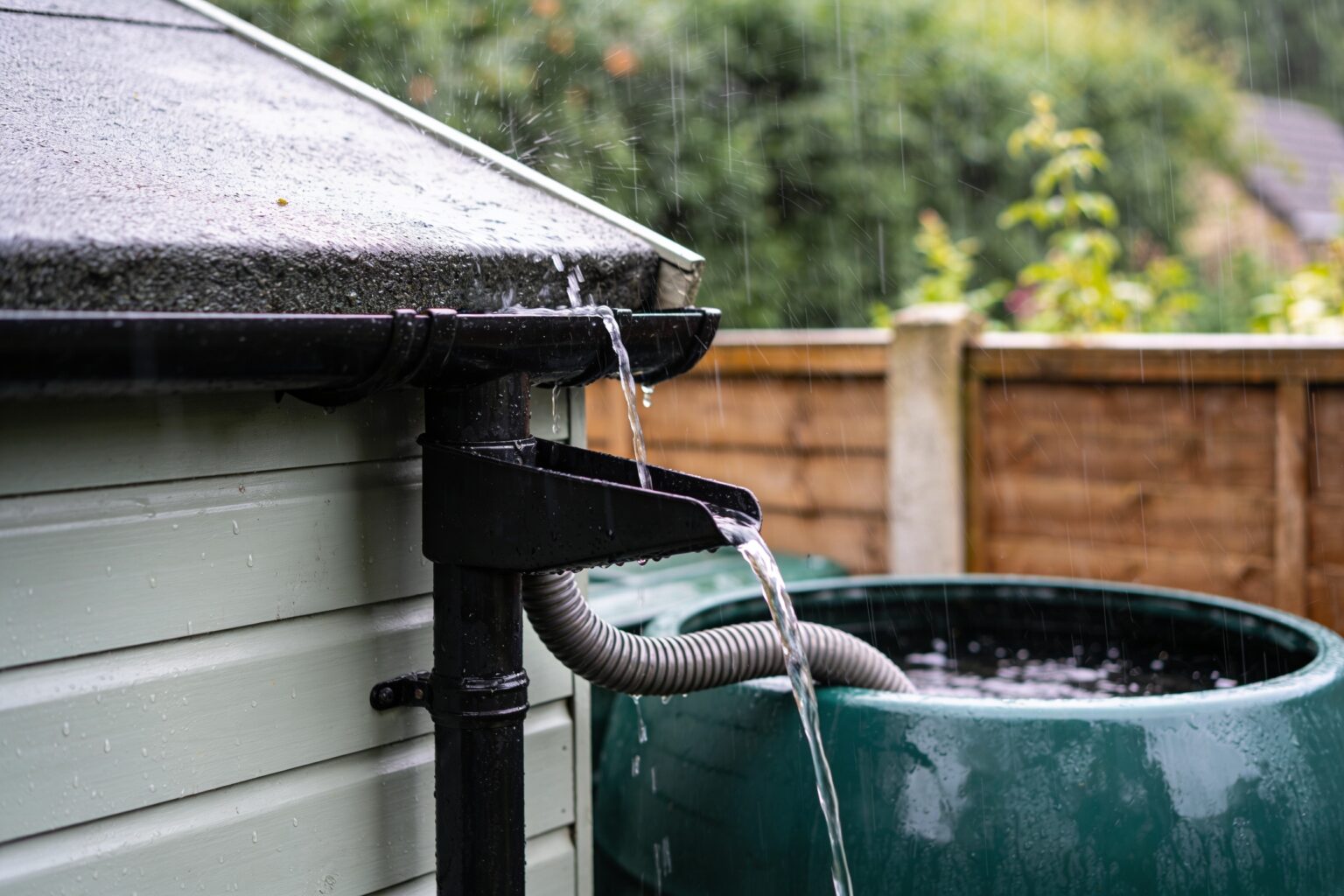
Quick answer: A water butt diverter fits into your downpipe and catches rainwater running down the inside of the pipe, sending it through a short hose into your butt. Because it sits level with the butt’s inlet, the water backs up once the butt is full and the rest carries on down the pipe to the drain. That means the butt fills automatically and never overflows.
If you’ve ever wondered how a water butt knows when to stop filling, the answer is the rain diverter. It’s a small, inexpensive fitting, but it’s what makes the whole system work. Understanding it makes fitting one much easier, and helps you fix problems if your butt overflows or won’t fill.
What is a water butt diverter?
A rain diverter goes by several names: rainwater diverter, filler kit, downpipe connector, rain saver or rain trap. Whatever it’s called, it does the same job. It sits in your downpipe, between the gutter and the drain, and redirects some of the water into your water butt.
A typical diverter kit includes:
- The diverter body, which fits into a gap cut in the downpipe.
- Adaptor rings so it fits round or square pipes.
- A short hose, often 25 mm or 32 mm, that runs to the butt.
- A tank connector and seals to fit the hose to the butt.
How does a rain diverter work?
When it rains, water doesn’t fall straight down the middle of a downpipe. Most of it clings to the inside wall and runs down in a spiral or a sheet. The diverter uses that.
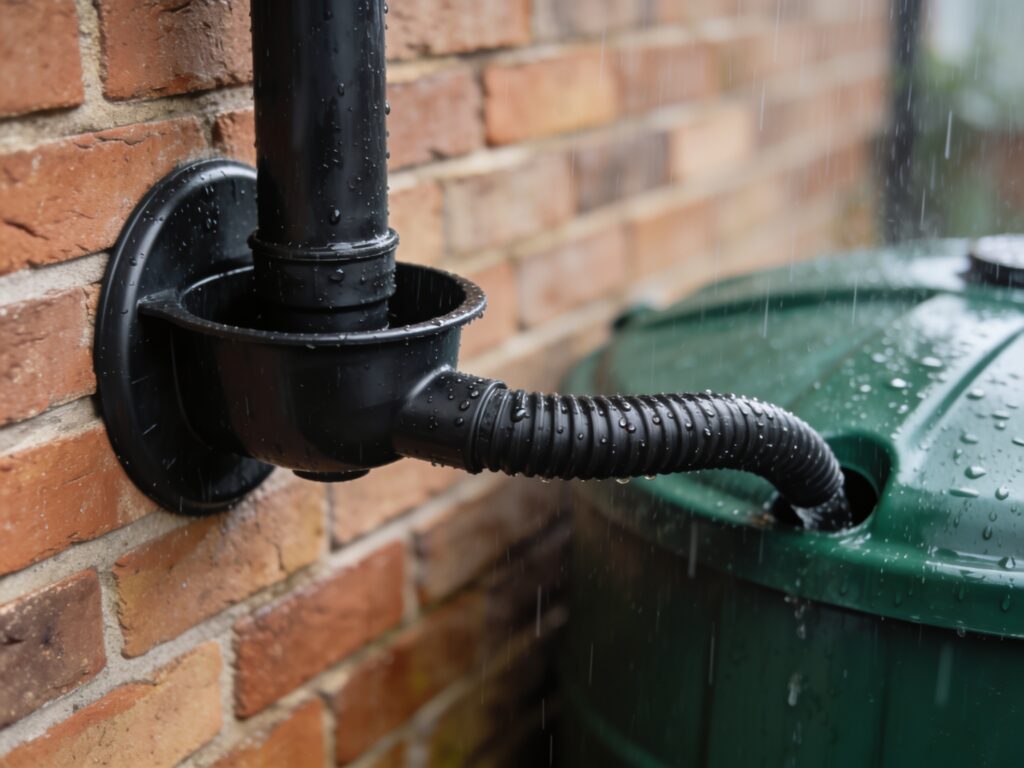
- A collar catches the water. Inside the diverter there’s a ring or lip around the inside wall. Water running down the pipe is caught by this collar.
- It flows out the side. The collected water runs out through an outlet on the side of the diverter and along the hose into the butt.
- The butt fills. As the butt fills, the water level rises in both the butt and the hose.
- The level reaches the diverter. Once the water in the butt reaches the same height as the diverter outlet, the hose is full and no more water can flow into the butt.
- The rest carries on down. With nowhere to go, the water caught by the collar overflows back into the pipe and runs down to the drain as normal.
It’s simple physics. Water finds its own level, so the butt can never fill higher than the diverter. That’s why getting the height right is so important.
Why the height matters
- Diverter too high: the water level in the butt can rise above the inlet and up to the rim before the diverter shuts off. Result: the butt overflows from the top.
- Diverter too low: water starts backing up into the diverter while the butt is still only part full. Result: you never get a full butt.
- Diverter just right: level with the butt’s inlet near the top. Result: a full butt and no overflow.
Rule of thumb: Fit the diverter so its outlet is level with, or just above, the inlet hole near the top of your water butt. Your kit’s instructions will give the exact measurement.
Types of water butt diverter
Standard diverter kits
The most common type. They fit standard plastic downpipes, usually 68 mm round and 65 mm square, often with adaptor rings so one kit suits both. They come in black, grey, brown and white to match your guttering. Most water butt kits include one.
Mini diverters
Porches, conservatories, sheds and some modern homes have smaller 50 mm downpipes. A standard diverter won’t fit, so you’ll need a mini version. Measure your pipe before you buy.
Diverters with filters
Some diverters have a mesh or filter that catches leaves, moss and roof grit before it reaches the butt. If you have trees nearby, they’re well worth it. Less debris means cleaner water and fewer smells. See how to keep water butt water clean.
Collector-style rain traps
Some kits, such as the Harcostar Universal Rain Trap, use a slightly different body design but work on the same principle: catch the water, send it to the butt, and let it carry on down once it’s full.
Gutter-mounted diverters
A few designs fit at the gutter outlet rather than in the pipe. They’re handy where the downpipe is awkward to cut.
-

Harcostar Universal Rain Trap Diverter Black Downpipe Water Butt Connector Kit with 0.5m Flexible Hose 25mm Diameter Fits 63mm 68mm 80mm 100mm Round and 61mm 65mm Square Plastic Pipes
£16.95 -
Karrma Ltd Water Butt Diverter Kit, Round and Square Downpipes | Filler Kit, Connects downpipe, Saves water and the environment
£11.98


Do you actually need a diverter?
Strictly speaking, no. You could cut the downpipe short and let it pour straight into an open-topped butt. But that causes problems:
- It overflows. Once the butt is full, water pours over the top and floods the base, unless you fit an overflow kit.
- Debris gets in. Everything that washes off the roof ends up in your water.
- There’s no lid. Open water attracts mosquitoes and is a safety risk for children and pets.
A diverter avoids all three, so for most homes it’s the tidier, cleaner and safer option.
How to choose the right diverter
- Measure your downpipe. Is it round or square, and how wide? Standard is 68 mm round or 65 mm square, and small pipes are around 50 mm.
- Check the material. Most diverters are made for plastic pipes. Cast iron is a different job.
- Match the colour to your guttering if looks matter.
- Check the hose size fits your butt’s inlet (25 mm and 32 mm are common).
- Consider a filter if trees overhang your roof.
How to fit a water butt diverter
The short version:
- Set the butt in place on a level stand.
- Mark the downpipe level with the butt’s inlet.
- Cut out the section of pipe your kit specifies.
- Slot the diverter into the gap.
- Connect the hose from the diverter to the butt.
For the full walkthrough, with photos and tips, see our step-by-step guide on how to fit a water butt.
Diverter problems and how to fix them
| Problem | Likely cause | Fix |
|---|---|---|
| Butt overflows | Diverter too high | Lower it level with the inlet |
| Butt won’t fill | Diverter too low, or hose blocked | Raise it, or clear the hose |
| Very slow filling | Filter clogged with leaves | Clean the filter and gutters |
| Water leaks at the joint | Pipe not pushed fully home | Reseat the pipe and adaptor rings |
| Diverter rattles or slips | Pipe cut too short | Use a longer offcut or a joiner |
Can one diverter fill two water butts?
Yes, indirectly. Fit the diverter to the first butt, then join the second butt to the first with a linking kit. As the first fills, water flows across to the second. Here’s how to link water butts.
Water butt diverter FAQs
Will a diverter stop my water butt overflowing?
Yes, if it’s fitted at the right height. Once the butt is full, the diverter lets the rest of the water carry on down the pipe.
Do diverters work in winter?
Yes, but in freezing weather the hose and diverter can ice up. Some diverters have a summer/winter setting that lets you shut off the flow to the butt in winter.
What size downpipe do I have?
Most UK homes have 68 mm round or 65 mm square plastic downpipes. Sheds, porches and conservatories often have 50 mm pipes. Measure the outside width of the pipe to be sure.
Can I fit a diverter without cutting the pipe?
Some designs only need a hole drilled in the pipe, or fit at the gutter outlet. Most standard kits do need a short section cutting out.
How much water does a diverter let through?
Diverters catch most of the water in light and moderate rain. In very heavy downpours, some water will always rush past the collar, which is perfectly normal.