Quick answer: For most UK back gardens, a 200 to 250 litre water butt is the right size. Small roofs such as sheds and greenhouses suit 100 litres. Big roofs, veg plots and allotments suit 300 litres or more, or several linked butts. To work it out, multiply your roof area in m² by 10 to see roughly how many litres a 10 mm shower gives you.
Choosing a water butt size isn’t about guessing. You only need two numbers, the size of the roof feeding your downpipe and how much water your garden uses, and you’ll know exactly what to buy.
This guide gives you the simple formula, worked examples for common roofs, a quick size table and the practical things to check before you order.
The one rule you need
1 mm of rain on 1 m² of roof gives you about 1 litre of water.
That’s it. A 10 m² roof catches about 10 litres for every millimetre of rain. A decent 10 mm downpour gives you around 100 litres.
In real life you’ll collect a bit less. Some water splashes off, evaporates from warm roofs or overshoots the gutter in heavy rain. Knocking off around 10 to 20 per cent gives a realistic figure.
Step 1: Measure the roof area
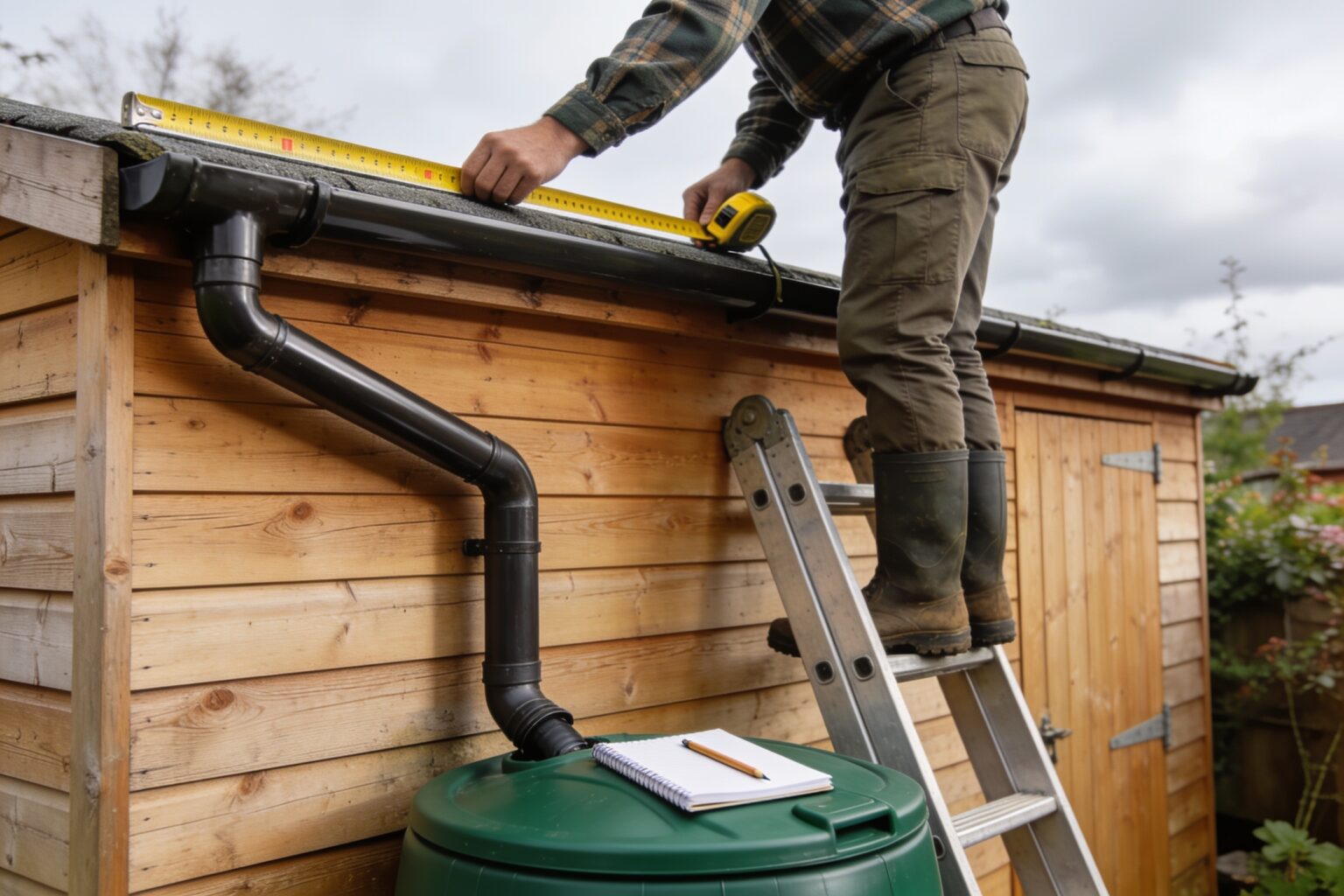
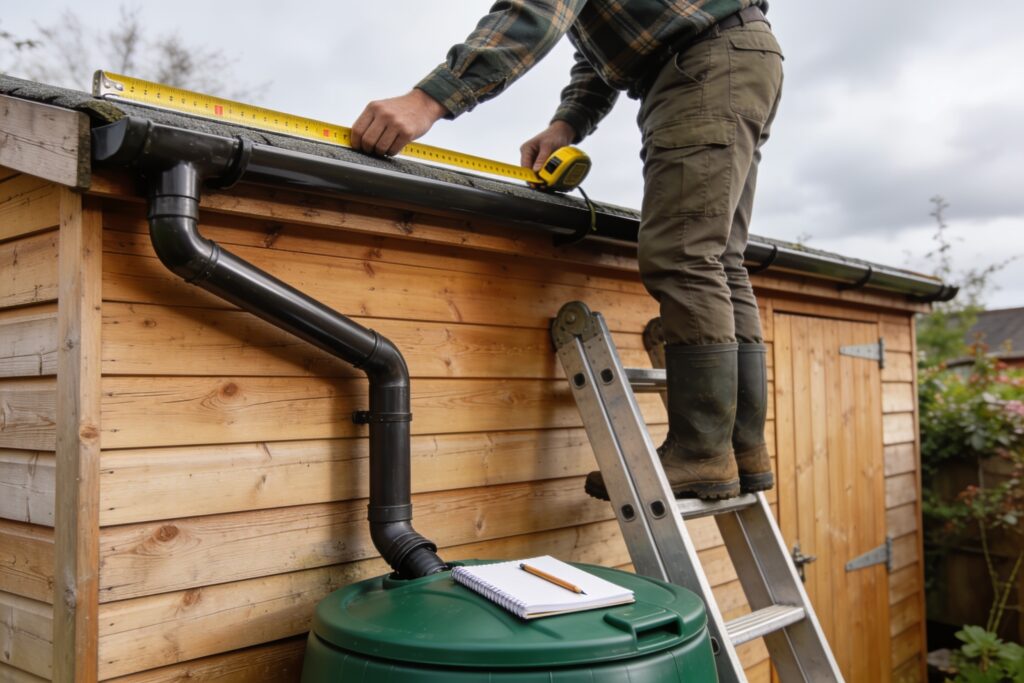
You need the area of the roof that drains into the downpipe you’ll use, measured flat, as if you were looking down from above. The pitch of the roof doesn’t matter for this. It’s the footprint that counts.
- Shed, greenhouse or garage: measure the length and width of the roof and multiply. A 3 m × 2 m shed is 6 m².
- House roof: a house roof usually drains to two or more downpipes. Work out the section feeding yours. Pace out the length of that side of the house and estimate how far the roof slope runs back.
Step 2: Work out how much water it collects
Multiply the roof area by the rainfall in millimetres. For sizing a water butt, it’s most useful to think about a single decent shower rather than a yearly total. A 10 mm downpour is a good everyday benchmark.
| Roof | Area | From 5 mm of rain | From 10 mm of rain | From 20 mm of rain |
|---|---|---|---|---|
| Small shed | 4 m² | 20 L | 40 L | 80 L |
| Large shed or greenhouse | 12 m² | 60 L | 120 L | 240 L |
| Single garage | 20 m² | 100 L | 200 L | 400 L |
| Section of house roof | 40 m² | 200 L | 400 L | 800 L |
These are worked examples using the one litre rule. Real yields will be a little lower.
What about over a year?
Over a whole year the numbers get big. Rainfall varies across the UK, from the drier south and east of England to the much wetter west and north, but even in the driest areas a roof collects a lot. The RHS notes that the roof of a small shed in dry south-east England can collect 2,500 to 3,500 litres of rainwater a year.
In other words, the roof is rarely the limit. In most of the UK, what really decides the right size is how much you can store between showers and how much you use.
Step 3: Think about how much water you use
The other half of the sum is demand. Roughly speaking:
- A few patio pots and baskets can get through a surprising amount in a hot spell. Pots dry out fast.
- A greenhouse full of tomatoes and cucumbers is very thirsty in summer.
- A veg patch or allotment needs the most of all, especially for newly planted crops.
- Established borders and lawns need very little extra water. Lawns recover by themselves after drought, so most gardeners don’t water them at all.
If your water butt runs dry every summer, you need more storage. If it’s always full and overflowing, you have enough, or you could add another butt on a different downpipe.
Step 4: Match the butt to your roof and garden
Here’s a simple guide:
| Your set-up | Suggested size | Where to look |
|---|---|---|
| Small shed, porch or greenhouse (under 10 m²) | 100 litres | Small water butts |
| Narrow side return, small garden | 100 to 250 litres slimline | Slimline water butts |
| Typical back garden (10 to 25 m² of roof) | 200 to 250 litres | 200 litre water butts |
| Big roof, veg plot, keen gardener (25 m² +) | 300 litres or more, or linked butts | Large water butts |
| Allotment or very large plot | 500 to 1,000 litres + | Rainwater tanks and IBC tanks |
One big water butt or several small ones?
Both work. It’s worth weighing up:
One large butt or tank
- Fewer connections and less to maintain
- Usually better value per litre
- Heavier, harder to place, needs a very solid base
Several smaller linked butts
- Easier to fit into awkward spaces
- You can start with one and add more later
- Spread the weight across a wider area
- Need linking kits and a little more fitting
Many gardeners start with a single 200 litre butt and add a second the following year. Here’s how to link water butts together.
Don’t forget the space and the weight
Before ordering, measure the spot as well as the roof:
- Footprint. A standard 210 litre round butt is usually around 55 to 60 cm across. Slimline butts are much shallower.
- Height. Remember to add the height of the stand, and leave room to open the lid.
- Weight. Water weighs 1 kg per litre, so a full 250 litre butt weighs over a quarter of a tonne. Always use a firm, level base.
Short on floor space? A slimline water butt sits flat against a wall, and square water butts fit neatly into corners.
Quick worked examples
Example 1: Small garden with a shed. Shed roof 2.5 m × 2 m = 5 m². A 10 mm shower gives about 50 litres. A 100 litre slimline butt fills after a couple of showers and suits a few pots and a small bed.
Example 2: Typical semi with a back garden. The rear downpipe drains around 20 m² of roof. A 10 mm shower gives about 200 litres. A 210 to 250 litre butt is ideal. Add a second linked butt if you grow veg.
Example 3: Allotment with a large shed and greenhouse. About 25 m² of roof combined. A 10 mm shower gives about 250 litres. Two or three linked butts, or a 1,000 litre IBC tank with a pump, would make sense.
Water butt size FAQs
What is the most common water butt size?
The 200 to 250 litre size is the most popular for UK gardens. It holds enough to keep a typical garden going between showers and fits beside most back doors.
Is a 100 litre water butt big enough?
For a shed, greenhouse or small garden with a few pots, yes. For a bigger garden, it will empty quickly in summer. You can always link a second butt later.
How long does it take to fill a water butt?
It depends on the roof and the rain. A 20 m² roof can fill a 200 litre butt from a single 10 mm downpour. A small shed roof might need two or three showers.
Can a water butt be too big?
Only if it never fills. A huge tank on a tiny roof will rarely be full, so you’re paying for space you don’t use. Match the butt to your roof.
How much does a full water butt weigh?
Roughly 1 kg per litre of water, plus the butt itself. A full 210 litre butt weighs over 200 kg, so it needs a firm, level base.
Still deciding which one to buy? See our round-up of the best water butts in the UK.